
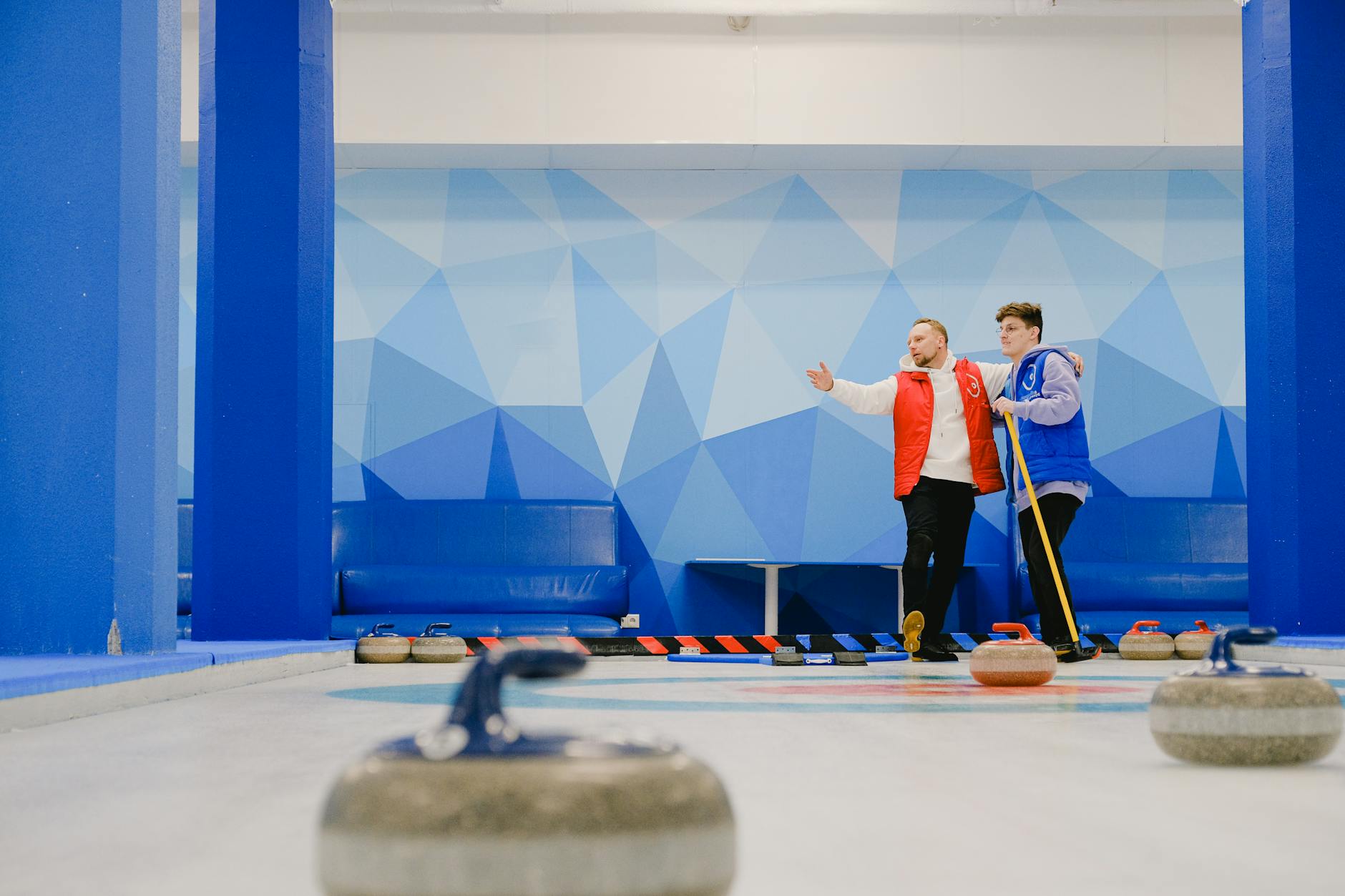
# Understanding the Power Play in Curling
**London, 6 February 2026** – As the Milano Cortina 2026 Winter Olympics commence, spectators are once again witnessing the strategic complexity of the “Power Play.” While the term is often associated with ice hockey penalties, in the context of curling, it is a tactical manoeuvre exclusive to the Mixed Doubles discipline designed to increase scoring potential.
## What is the Power Play?
In Mixed Doubles curling, each end begins with two stones already positioned on the ice: one “stationary” stone belonging to the team with the advantage (the hammer) and one “guard” stone belonging to the opposition.
Under standard play, these stones are placed on the centre line. However, once per game, the team with the last stone advantage (the hammer) can elect to use their **Power Play**. When called, the officials move these pre-placed stones from the centre to either the left or right side of the sheet.
The purpose of this shift is to clear the “four-foot” and centre paths, creating an open house that allows the offensive team to develop more complex angles and potentially score multiple points.
## Key Rules and Restrictions
The Power Play is governed by strict World Curling regulations to ensure it remains a balanced strategic tool:
* **Frequency:** Each team may only exercise the Power Play option **once** per game.
* **Eligibility:** It can only be called by the team that has the decision on the placement of the “positioned” stones (the team with the hammer).
* **Timing:** The option must be exercised at the beginning of an end.
* **Extra Ends:** The Power Play cannot be used during extra ends (overtime). It is strictly for use during the eight regulation ends.
* **Stone Placement:** One stone is placed as a corner guard, while the other is placed behind it in the house, tucked away from the centre.
## Power Play Technical Specifications
| Feature | Mixed Doubles Regulation |
| :— | :— |
| **Availability** | Once per team, per game |
| **Discipline** | Mixed Doubles Only |
| **Placement** | Moved to the wings (side of the sheet) |
| **Requirement** | Must have the “Hammer” (Last Stone Advantage) |
| **Restriction** | Prohibited in Extra Ends |
## Frequently Asked Questions
### Does a Power Play mean the other team has fewer players?
No. Unlike ice hockey, where a power play results from a penalty, a curling Power Play is a tactical choice regarding stone placement. Both teams continue to play with their full complement of two players.
### When is the best time to use it?
Teams typically use the Power Play when they are trailing in the second half of the game (usually between ends 5 and 8) to create a “big end” and score three or more points. However, if a team is leading, they may use it defensively to keep the centre of the ice clear and simplify the end.
### Can it be used in the traditional four-player game?
No. The Power Play is currently a rule specific to Mixed Doubles curling and is not utilised in the traditional Men’s or Women’s team events.
### What happened with the “Power Outage” in Cortina?
While unrelated to the tactical rule, the opening matches of the 2026 Winter Olympics in Cortina d’Ampezzo on 4 February were briefly interrupted by a literal power outage. Play resumed shortly after, with Great Britain and Canada securing early victories in the Mixed Doubles round-robin stage.